


Who Ruled Ancient Egypt?
The rulers of Ancient Egypt were called pharaohs. Pharaohs were both the heads of state and the religious leaders of their people. Pharaohs were considered to be divine because they served as the go-between for the gods and Egyptians. Pharaohs, however, had help from the priests to make laws, collect taxes and oversee the country. The priests who were highly educated also controlled the most important aspects of life in Ancient Egypt.
Priests were also healers of the sick and embalmers who prepared dead bodies for burial. Some priests also served as sculptors, musicians, lawyers, and teachers. They were in charge of religion and learning. They also controlled linen manufacture and any positions in the army that needed knowledge of arithmetic. Linen is a natural fabric made from the fibres of the flax plant.
Priests also served as royal chroniclers or storytellers, keepers of records, engravers of inscriptions, physicians or healers, pharmacists, and musicians. In short, they were in charge of the most skilled professions or work. Imhotep was an example of one of Ancient Egypt’s knowledgeable and versatile priests. Imhotep was held in very high esteem because he was an adviser to Pharaoh Zoser, who reigned between 5345 and 5307 BC. In addition, to being an adviser to the king, Imhotep was an astronomer. An astronomer is someone who studies stars and space. He was also an architect and the chief physician of the Pharoah. After he died, people worshipped him as the God of medicine, and a temple was built in his memory in the city of Memphis.
Even though priests wielded much power, they were fair and just. For example, wealthy people who had serfs were not allowed to mistreat them. Serfs were poor people who farmed on lands that did not belong to them. The lands usually belonged to the landlords. The penalty for killing a serf was death. Ancient Egypt was so safe when the priests ran most things that private citizens did not need to carry arms. Even soldiers were not allowed to carry arms except when they were on duty. All these examples prove that Egyptian society was orderly and safe. All of these made Egypt very wealthy during the height of its civilization. Artworks made during this period, prove that domestic or family life was peaceful, women were treated well, and children were well cared for. There were laws to protect the poor and the rich.
Where did people live when ancient Egypt was at its best?
At the height of Ancient Egypt’s glory, the wealthy people built magnificent mansions in cities like Thebes. Cities in Ancient Egypt had avenues and tree-lined boulevards. Some of the luxurious Egyptian mansions had as many as fifty rooms. These mansions were decorated with paintings, expensive furniture and sculptures made from bronze, ebony and ivory, which came from the heart of the African continent. Trading was one of the ways that Egypt was connected to the African interior.

What Are Pyramids and Sphinxes?
Egyptian pyramids are massive monuments with a square base and four smooth-sided triangular sides. They were used as royal tombs or final resting places for pharaohs. Pyramids were built with underground burial chambers that were deep inside them. The burial chambers were filled with treasure and items for the Pharaoh to use in the afterlife because the Egyptians believed in life after death. The chamber walls were covered with carvings and paintings. Pyramids also had other rooms where family members and servants of the pharaohs were buried. There were often small rooms that served as temples and larger storage rooms. A sphinx is a huge statue built with the body of a lion and a human head out of limestone.
The size of the sphinxes and pyramids made some historians think that the only way they could have been built was through slave labour, that is, unpaid workers. However, other historians like Flinders Petrie, who studied Life in Ancient Egypt, believe that no slaves were used to build the pyramids. His research led him to conclude that slavery in Egypt was not like slavery in Ancient Greece and the Roman Empire. His findings show that in Ancient Egypt, at the time of the building of the pyramids and sphinxes, there was a system of labour in place, which made slave labour unnecessary.
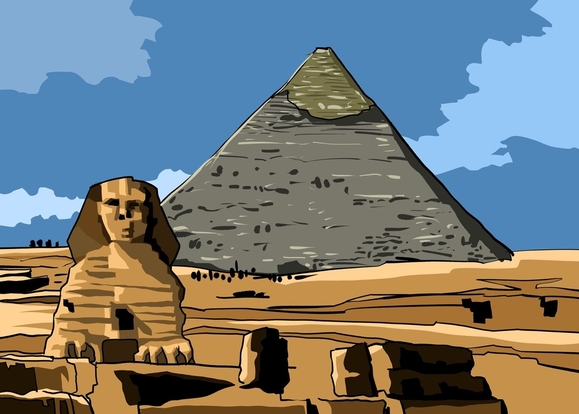
How were the Pyramids and Sphinxes built?
John Jackson, a great historian, also tells us that the building of the Pyramids in Egypt was a highly organized project. Builders of the pyramids were hired twice in their lifetime to work for three months at a time. Although the work was compulsory, it allowed builders to earn a decent living and gain technical expertise. It took about ten years just to get the rocks to the site where the pyramids were built. The project needed a hundred thousand people who worked in three-month shifts or work periods to transport stones to the construction site. The actual construction or building took another twenty years.


