

The Story of Africa for Kids - Chapter 2
Many historians, believe that the ancient Egyptian civilisation started around 10,000, 8,000 or 5,000 years ago. Historians are people who study the past. Although historians are not sure of the exact time, the most important thing to remember is that Egypt is the earliest civilisation. It is older than any other civilisation found anywhere else in the world.
It is believed that the Egyptian Civilization lasted for more than 3000 years and was divided into two kingdoms spanning 30 dynasties. Kingdoms were made up of many cities where people lived. Dynasties were the royal families who ruled over the cities or kingdoms. Other civilisations like the Greek and Roman, which came after Egypt, all learned a lot from the Egyptian civilization.
The Egyptians established vital routes of trade and constructed cities with amazing architectural marvels, many of which are still standing thousands of years later. The River Nile provided everything the Egyptians needed to create one of the greatest civilizations that ever existed on earth. The river provided the water that was needed to grow crops. The Egyptians became experts at irrigation, since there were times when the water overflowed, and times when it ran dry. The Egyptians were so proficient at growing food that they were able to supply the food that they needed. They then sold their excess crops to other kingdoms.
What Type of Religion Did The Egyptians Practice?
The Egyptians had a form of religion with many gods and goddesses. They believed in an after life and so they developed a sacred system of preserving the bodies of dead people by applying sacred oils and wrapping them in cloth. The system of preservation is known as mummification. The remains of the dead that are preserved this way are called mummies. The rulers of Egypt were known as Pharaohs. Most pharaohs were men, but there were a few female pharaohs too.
How do we know so much about Ancient Egypt?
Much of what we know about this great African civilisation comes from archaeological remains that are ancient objects and writings such as the Edfu text. The Edfu texts are stone carvings found in the Temple of Horus in the area where Ancient Egypt was located.
The Edfu texts record how the area that became Egypt was conquered by a man called Horus, who came from somewhere south of Egypt. Horus become the ruler of the people he met in the area just as he had conquered the people he met on his way from the south of the African continent. Horus brought a lot of valuable skills with him to Egypt such as how to smelt and turn iron into tools and weapons. His followers were skilled blacksmiths. After he died, king, Horus was worshiped as a god. The place that Horus came from initially has been identified as somewhere around Somaliland or Uganda.
What Did Ancient Egyptians Call their Country?
The Ancient Egyptians called their country Kemet, which means ‘Black Land.’ Kemet or Ancient Egypt as we now call it was a highly developed country. It was highly developed in many fields of study, such as astronomy, architecture, the arts, science, technology, religion, mathematics and writing in the form of hieroglyphics.
What are hieroglyphs?
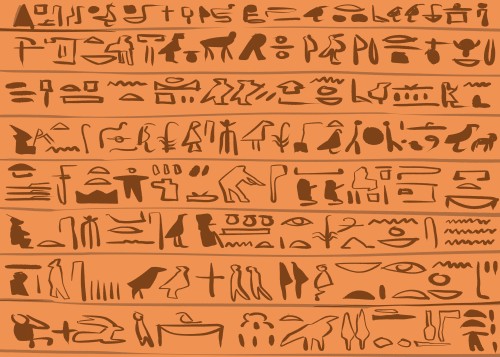
The Ancient Egyptians are believed to have been the first to develop writing. They came up with hieroglyphics, a form of writing which combines pictures, symbols and letters comprising about 1,000 distinct characters. The cursive version, a slightly different type of hieroglyphics, was used to write religious inscriptions on papyrus and wood by priests who were also historians and keepers of records.
What is papyrus?
Papyrus was a kind of writing material used instead of paper. Papyrus was made fro the stem of a plant which grew around Egypt.
End of chapter 2
In the next chapter we will learn about the Pyramids and Sphinxes So watch out for the continuation of the fascinating history of Africa


